Understanding French pressure against the European Union-Mercosur agreement
29/11/24 - Leandro Gilio | Marcos Jank | Victor Martins Cardoso
International Trade | Geopolitics | Image and Communication

What is at stake in the negotiations between the blocs and what is bothering French beef producers about reaching a possible agreement?
In a letter addressed to the president of the National Federation of European Farmers' Unions, Carrefour's global CEO, Alexandre Bompard, has provoked intense backlash in recent days by attacking the image of Brazilian beef. The executive of the French retail group warned of an alleged "risk of flooding the French market with meat [from Mercosur] that does not meet requirements and standards" and adopted a highly protectionist stance by declaring that the chain "will not sell any meat from Mercosur."
In response to the unfounded criticism, Brazil, including industry entities, the government and meatpacking companies, reacted firmly by threatening to boycott the supply of meat to the Carrefour group in Brazil. The pressure had an effect, leading the company and its Global CEO to back down by issuing public statements, acknowledging that Brazil “supplies high-quality meat, with respect for standards and flavor”. However, the controversy went beyond the dispute with Carrefour and took on greater proportions on November 26, during the symbolic vote on the agreement between the European Union and Mercosur in the French National Assembly. At the time, French deputies intensified their attacks on the quality and health standards of Brazilian meat, refusing to ratify the agreement between the two large blocs. Therefore, it is essential to understand the reasons for such attacks and what is at stake at this long-standing negotiating table.
First, it is important to highlight the lack of basis for the attack on the sanitary conditions and quality of beef produced in Brazil. Brazil currently ships beef to more than 170 countries, with an inspection service (SIF) that is widely recognized worldwide, meeting the high levels of product quality for different markets, sanitary standards and recommendations of the World Organization for Animal Health (WHO). It is extremely strange that the global CEO of Carrefour, a large retail group with more than 1200 stores in Brazil alone and which has been selling Brazilian beef in the country and around the world for many decades, is unaware of these facts. Such an attitude leads one to believe that the real motivation behind this crisis is to give voice to and explicitly support local European producers, who have been trying to block a trade agreement between the two blocs for more than two decades.
Today, beef exports to the European Union face severe restrictions, mainly due to the existence of tariff rate quotas (TRQ). This mechanism establishes a volumetric limit on meat imports into the bloc within a reduced import tariff, called an intra-quota, accompanied by a much higher tariff for all imports that exceed the quota, called an extra-quota tariff. The quotas and tariffs related to beef imports are listed in the table below, with some extra quotas granted to specific countries. However, the European market is highly restricted, with import quotas of approximately 115 thousand tons, which correspond to less than 2% of the approximate annual consumption of 6,2 million tons of beef by the bloc (USDA, 2024). In 2024, beef imports from Mercosur represent only 6% of total beef imports from the European Union and the United Kingdom, while intra-bloc imports account for 92% of total imports. This shows that the biggest problem for the French is competition within Europe, and not the low volumes coming from Mercosur.

Source: prepared by Insper Agro Global.
In addition to a fairly protected market, European farmers receive subsidies from the Common Agricultural Policy (CAP), a state aid program implemented in the economic bloc since 1962, with French farmers as the main beneficiaries – further reducing the competitiveness of meat from other markets. Currently, CAP subsidies are undergoing reforms aimed at encouraging more sustainable production practices, which has also contributed to the wave of dissatisfaction among producers (see more in an article published on agricultural protests in Europe ).

Source: WTO (2024). *Quotas open to specific countries, which are exceptions to common quotas. ** The so-called Hilton quota refers to meats considered to be of high quality and that meet very specific criteria.

Source: prepared by Insper Agro Global based on data from Trade Data Monitor and USDA (2024). *percentage values correspond to the CAGR calculation for the period.
Meat exports from Mercosur and Brazil to the European Union are decreasing – on average, an annual decrease of 1% from 2000 to 2024 (Figure 3).

Source: Trade Data Monitor (TDM, 2024). *1% annual decline refers to the CAGR calculation for the period.
The protectionist scenario for European cattle farming should remain virtually unchanged even with the eventual ratification of the agreement between Mercosur and the European Union, as indicated by the terms recently negotiated. Table 2 below shows that, although the proposal foresees greater openness and preferential quotas for Mercosur, the permitted volume would represent only 1,5% of the European consumer market. This percentage, added to the maintenance of restrictions and high subsidies after ratification, renders the argument of a possible “flooding of the market” with meat from the South American bloc unfounded.

In addition to tariff and quota barriers, the European market imposes strict technical and bureaucratic restrictions. The extensive legislation and lengthy licensing processes are such significant obstacles that Brazil is often unable to use its entire available quota for high-quality meat (Hilton quota[1]), as exemplified in Table 3, for the year 2024. Failures in this process and coordination difficulties hinder access to this available market and represent yet another barrier. Such issues are an even greater incentive (in addition to the high demand) for the direction of beef produced in the country to other regions, such as China, which currently absorbs more than 50% of Brazilian beef shipments, leading among the region's destinations (Figure 3). The Mercosur-EU Agreement tends to facilitate the approval of Brazilian processing plants for export, through a pre-listing system, eliminating the need for individual inspection of plants and speeding up the qualification of exporters.

Source: Secex (2024). *quota for the period of validity from 1/7/2024 to 30/6/2024

Source: Trade Data Monitor (TDM, 2024).
Finally, the recent attacks on the image of the Brazilian livestock sector essentially reflect the protectionist strategy of an interest group (French producers), despite the limited impact that the trade agreement would have if implemented. The European Union is currently divided over the ratification of the agreement, with some countries opposed (France and Poland, for example) and others in favor of the treaty (such as Germany and Spain). The agreement has been under negotiation for over 20 years and has gone through several phases. At the moment, there is optimism that it will be implemented, given the European Union's need to secure markets and minimize the geopolitical and commercial influence of other regions or countries, such as China. It remains to be seen to what extent French producers and opposing movements will be able to mobilize forces against the ongoing negotiations.
[1] To qualify for the Hilton Quota, beef must meet several requirements, which involve carcass conformation; level of fat coverage; weight; presence of incisor teeth; animal registration; farm certification; slaughter rules; and authorization of the slaughterhouse to export to the European Union.
* Use this material as a reference freely.
All Agro in Data graphs and data are available for use. You have permission to use, distribute and reproduce these contents in any medium (graphs and data are open to embedding), as long as sources and authors are credited.
Data produced by third parties and made available on Agro in Data are subject to the license terms of the original authors. We will always indicate the original source of the data in the documents made available, and it is the user's responsibility to always verify and cite the original sources.
Are you already following our official channels? Click and follow our WhatsApp channel , follow us on LinkedIn , and subscribe to receive our bi-weekly newsletter . Stay updated with research and knowledge on global agribusiness issues.
Read too
Articles in newspapers and magazines | Insper Agro Global | 10/30/26
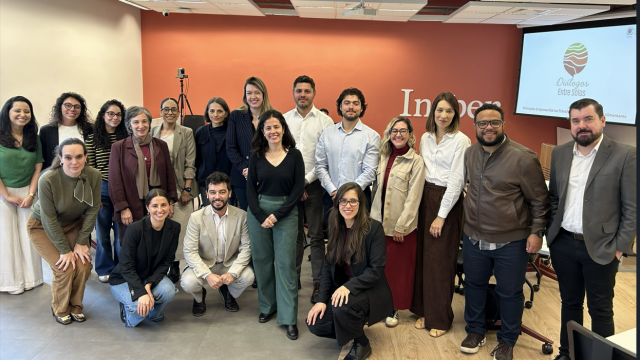
Insper and the UN Global Compact form a partnership to promote sustainable food systems.
Cooperation involves Insper Agro Global and Insper Metricis in the Soil Dialogues and foresees technical contribution to a document of business principles.
Articles in newspapers and magazines | Estadão | 18/10/26
Between Washington and Beijing, Brazil's interest
Food, energy, and minerals give the country bargaining power with the two superpowers.
Articles in newspapers and magazines | Estadão | 04/10/26
New challenges in global supply chains