How Brazilian agribusiness should position itself in the new geopolitics
21/05/25
Geopolitics | International Trade

Event promoted by Insper Agro Global and Cebri discussed the impacts of tensions between the US and China on Brazil and the future of global trade
In light of the growing instability in international relations and the resurgence of protectionism as a tool for geopolitical dispute, Insper promoted the event "Agribusiness in the New Geopolitics – Challenges and Opportunities in the Trump 2.0 Era" . Organized by the Insper Agro Global group with the support of the Brazilian Center for International Relations (Cebri) and the student organizations AgroInsper and the Insper International Relations League, the meeting brought together experts to discuss the impacts of trade tensions between the United States and China on Brazilian agribusiness and the global economy.
The opening was led by Marcos Jank, coordinator of Insper Agro Global, who highlighted the relevance of the topic, especially after the surprising trade truce signed between Washington and Beijing a few days before the event, on May 12. “No one imagined that the United States and China would reach an agreement now. Tariffs fell as quickly as they rose. This is a strategic moment to analyze the impacts of this on Brazil,” noted Jank.
The backdrop to the discussions was the recent US decision to reduce tariffs on Chinese goods from 145% to 30%, while China lowered its tariffs on US imports from 125% to 10%. The so-called “90-day truce” served as a starting point to reflect on the short- and long-term effects on global trade, especially in the agro-export sector.
Ariane Costa, deputy director specializing in geopolitics and international trade at Cebri, contextualized the current moment as part of a broader transformation of the international system. “Today we are experiencing what many call a 'perfect storm.' Simultaneous crises — trade, health, fiscal, climate — are overlapping, requiring Brazil to act with a clear strategy and a proactive stance on the international stage.”
Among the most relevant points raised by Ariane, the change in the way the US perceives other global powers stood out. “Trump no longer sees Russia as an enemy, but as a strategic ally. This points to a new global configuration, based on the tacit acceptance of spheres of influence: Russian, Chinese and American.”
She also drew attention to the risks of unpredictability: “The private sector prefers a bad but stable scenario to an environment where everything can change from one day to the next. And that is exactly what we have seen. On April 2, for example, the US increased tariffs on Chinese products on what is known as ‘Liberation Day’. Shortly after, they backed down, and this past weekend they announced a new truce with a new round of negotiations in Geneva.”
Direct competition and pendulum diplomacy
Ariane also highlighted the competitive nature of the trade relationship between Brazil and the United States in the agricultural sector. “Our agricultural trade with the Americans is one of direct competition, not complementarity. We export the same products — soybeans, corn, meat — to the same markets. This needs to be taken into account when formulating Brazilian foreign policy.”
In this context, he defended a strategic diplomacy that explores opportunities with both poles of power: “Brazil can adopt a swing diplomacy — signing advantageous agreements with the US in certain areas and with China in others, without automatically aligning itself with either side.”
“A new order, or a prolonged disorder”
Marcos Jank then reinforced the diagnosis of global disorganization. “Trump ignores multilateral institutions. He prefers direct, asymmetrical and unilateral relations. Today there is no room for governance based on the UN, G20, G7 or WTO. What we have is a new order — or, more precisely, a prolonged disorder.”
He also criticized the logic behind the April tariff hike, which was calculated based on the U.S. trade deficit with each country: “This formula — deficit divided by trade volume — has no basis in any economic theory. Yet it was the reasoning that led to absurd tariffs.”
With the recent tariff reduction, Jank points to a return to “almost normal,” but with effects already being felt: “With tariffs at 125%, the US was practically unable to export to China, especially agricultural products. This momentarily favored Brazil. Now, with the reduction to 10%, this advantage has practically disappeared.”
Jank also warned of the risk of a deeper agreement between the US and China, in which the Chinese are pressured to buy more American agricultural products. “If this happens, Brazil could lose ground. And if it is perceived as being too aligned with China or Russia, it could suffer retaliation from Washington.”
For him, the best stance is pragmatic neutrality: “Brazil must position itself as a reliable, competitive and impartial supplier. We have the largest agricultural surplus in the world and we cannot run the risk of being excluded due to ideological alignments.”
When the tariff becomes an embargo
In his presentation, economist Roberto Dumas addressed the macroeconomic effects of recent protectionist measures. “With tariffs of 125% or 145%, what we have is, in practice, a trade embargo. It would be more honest to say: ‘you don’t buy from me, I don’t buy from you’.”
He highlighted the direct impact of these measures on American inflation: “There will be a shortage of Chinese products. Trump wants to bring industries back to the US, but he ignores comparative advantages. No company makes long-term decisions based on 90-day tariff surges.”
According to Dumas, unpredictability is the economy’s greatest enemy: “Risk can be managed. Uncertainty cannot. If no one knows whether the tariff will be 34%, 67% or 145%, no one will invest. And it was this environment that the market began to price in.”
Regarding the exchange rate, he was blunt: the yuan will not replace the dollar as long as China maintains control over its capital account. “You can make a billion yuan in a trade, but where do you invest that money? In Shanghai? Shenzhen? You can’t. If you’re going to convert it into dollars, it’s better to trade in dollars from the beginning.”
Agriculture in the face of the tariff war
Researcher Leandro Gilio focused his analysis on the direct effects on Brazilian agriculture. “The key word is uncertainty. The Trump administration had already signaled, since the campaign, a tightening of tariffs. But the intensity surprised even the most pessimistic analysts.”
For him, agribusiness is the most impacted sector: “Direct competition with the US in the main products that China imports — soybeans, corn, cotton, meat. In 2018 and 2019, Brazil benefited from the trade war and gained market share. But this advantage is unsustainable in such an unstable environment.”
He warned that the real risk lies in the lack of predictability: “Instability limits investment. When the market sees an opportunity with a tariff increase, a simple change over the weekend can cancel everything out. That’s what we’ve seen now: an unexpected reversal in 90 days. And no one knows if this will last.”
Gilio concluded by highlighting the impact on planning: “This unpredictability contaminates the business environment and compromises investment. Even sectors that benefit from the trade war have difficulty operating safely in the face of such abrupt changes. Caution is needed before considering any scenario as favorable.”
Caution, pragmatism and strategic action
At the end of the event, the consensus among participants was clear: Brazil needs to adopt a strategic, pragmatic and long-term stance. The new international order — or disorder — demands more than immediate reactions. It demands leadership, coordination and, above all, internal predictability to face an increasingly volatile world.
In his closing remarks, Marcos Jank defended the addition of value to Brazilian exports: “We are leaders in commodities, but we still do little in terms of added value. There are opportunities in coffee, fruits, meats, olive oils, cheeses and wines. The Europeans are much better at this. We need to learn.”
Regarding the global scenario, Jank was categorical: “Trump not only tore up 70 years of multilateral institutions — from GATT to the WTO — but also ignored 250 years of economic theory, dating back to Adam Smith. He thought that tariffs would recreate American industry. The result was inflation, the risk of recession and the disorganization of production chains.”
Finally, he assessed the recent truce as a sign of reality setting in: “The April tariff hike was unsustainable. The American economy was at risk. The reduction to levels of 10% and 30% reveals a reality check.”
Jank concluded on a sober note, but with room for strategic optimism: “We still don’t know what will happen in the next 90 days. But if there is moderation, the impact could be manageable for all sides. It is up to Brazil to remain calm, avoid automatic alignments and position itself as a reliable, competitive and neutral supplier in this new global scenario.”
You can watch the debate Agriculture in the new Trump era clicking here.
Are you already following our official channels? Click and follow our WhatsApp channel , follow us on LinkedIn , and subscribe to receive our bi-weekly newsletter. Stay updated with research and knowledge on global agribusiness issues.
Read too
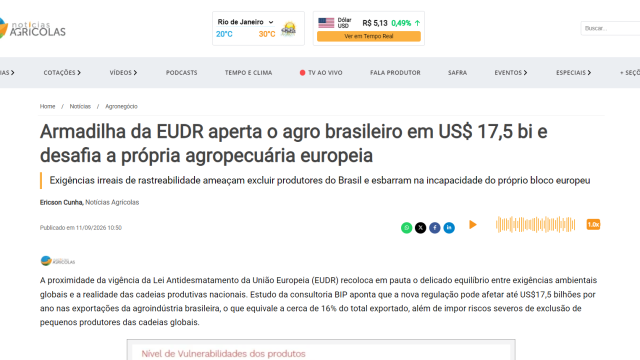
News | Agricultural News | 09/11/26
The EUDR trap tightens the Brazilian agricultural sector's grip by US$17,5 billion and challenges even European agriculture itself.
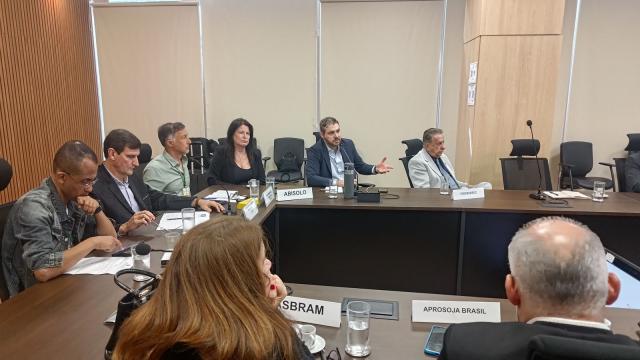
News | Insper Agro Global | 08/28/26
José Pimenta participates in a debate on geopolitics and the competitiveness of agricultural inputs.

News | Insper Agro Global | 05/19/26
Insper Agro Global announces new collaborators and expands its operations in geopolitics and international trade.
José Pimenta Jr. and Bruno Capuzzi join the research team, strengthening research on topics related to international trade, public policy, and global regulatory governance.