The suspension of the Harvest Plan and concerns about investments in the sector
02/27/25 - Luiz Arthur Chiodi Pereira | Leandro Gilio

Wenderson Araújo/Trilux | CNA/Senar System
Budgetary difficulties have led to the suspension of credit lines under the country's main agricultural financing program and are creating uncertainty among producers
With 21 years of existence, the Safra Plan has consolidated itself as a fundamental pillar of agricultural policy in Brazil, contributing to the continuous modernization of agribusiness and to the necessary investments that drive the sector's significant productivity growth. Food security in the country is also related to this public initiative, which seeks to stimulate agricultural production through tax incentives, support programs for rural producers, insurance and specialized technical assistance.
The fundamental aspect of the Plano Safra (Harvest Plan) is the financing of production and investment through subsidized credit lines, distributed by various public and private financial institutions, encouraging production (cost), marketing, and modernization of agricultural activities. Although the program has lost some ground in production financing due to the growth of recent credit operations in the capital market, such as CRA and Fiagros operations, it still has considerable relevance in the sector, mainly because it serves different profiles of rural producers and focuses especially on small and medium-sized producers, covered by the incentives of Pronaf (National Program for Strengthening Family Farming) and Pronamp (National Program for Support to Medium-Sized Rural Producers), in addition to prioritizing the financing of production "within the farm gate" (read more about this in Agro In Data under " Is rural credit keeping pace with the growth of Brazilian agribusiness? ").
The credit encouraged for financing and investment is complemented by other financing lines linked to the Safra Plan, such as Moderagro (Program for the Modernization of Agriculture and Conservation of Natural Resources), Inovagro (Program for the Incentive of Technological Innovation in Agricultural Production) and Moderfrota (Program for the Modernization of the Fleet of Agricultural Tractors, Implements and Harvesters).
In 2024, the federal government announced an investment of approximately R$ 476 billion in the 2024/25 Harvest Plan, the largest amount of resources ever allocated to the program historically. Of this amount, R$ 400,59 billion would be allocated to so-called "commercial" agriculture, among the various lines of credit, and R$ 76 billion to the "family" category, through Pronaf (National Program for Strengthening Family Farming). Interest rates for commercial agriculture were projected to range between 7% and 12%, while family farming would have access to resources with rates between 0,5% and 6% (read more in " 2024/25 Harvest Plan aims to allocate R$ 476,6 billion in credit to agribusiness ").
With the continued rise in the basic interest rate (Selic), currently at 13,25% per year and with no prospect of a reduction — since inflation is still at worrying levels in the context of national monetary policy —, it is becoming increasingly costly to maintain credit lines subsidized by the government. As a result, on February 21, most of the financing lines of the Safra Plan were suspended by the government, with only the Pronaf line remaining active.
This suspension is due, in addition to the significant increase in spending on equalizing interest rates due to the recent increase in the Selic rate, also to the delay in voting on the Annual Budget Law (LOA), which should have been approved in December, but had its vote postponed to March.
This is a particularly delicate moment for the suspension of the program's credit lines, as it occurs at a time when producers are preparing for planting and making commitments to invest in production.
Currently, food inflation has been a concern in the country, exceeding 7% in 2024 and reaching a positive variation of 0,96% in January 2025 in Brazil. This scenario is due to a series of factors, including the increase in production costs. The cancellation of the credit lines of the Harvest Plan, therefore, is yet another pressure to increase the costs of crop formation, herd renewal and infrastructure investments, making them even higher, which certainly must be, in part, passed on to the end consumer of food. In addition, the suspension of subsidized credit lines mainly affects smaller producers, who have reduced capacity to conduct negotiations or offer greater guarantees to financial institutions and, as a result, end up facing higher interest rates.
Several agribusiness entities have already expressed concern about the impossibility of new financing contracts and the consequent impossibility of financing production and investments. In response, the government issued provisional measure (MP) 24/02 last Monday, February 1.289, which releases extraordinary credit of R$2025 billion to meet the demands of the 4,17/2024 Harvest Plan. Of this amount, R$25 billion will be allocated to agricultural financing operations, marketing of agricultural products and rural and agroindustrial investment, while another R$3,53 million will be allocated to Pronaf.
However, high interest rates and the government's well-known budgetary difficulties are already putting even the 25/26 Harvest Plan in check, generating the possibility of higher costs and uncertainty for rural producers in planning the necessary investments. In other words, at a time when the Brazilian government is looking for alternatives to stop the rise in food prices, this is yet another factor that could result in higher prices.
Are you already following our official channels? Click and follow our WhatsApp channel , follow us on LinkedIn , and subscribe to receive our bi-weekly newsletter . Stay updated with research and knowledge on global agribusiness issues.
Read too
News | Agricultural News | 09/11/26
The EUDR trap tightens the Brazilian agricultural sector's grip by US$17,5 billion and challenges even European agriculture itself.
News | Insper Agro Global | 08/28/26
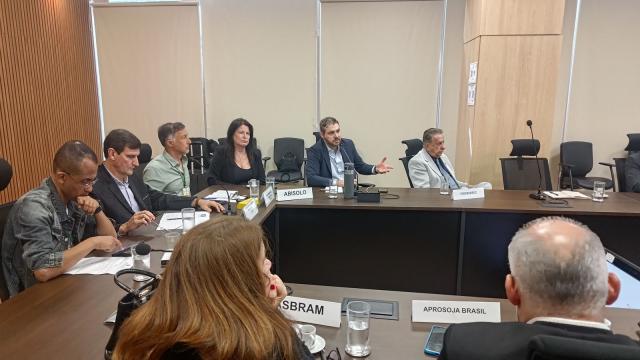
José Pimenta participates in a debate on geopolitics and the competitiveness of agricultural inputs.

News | Insper Agro Global | 05/19/26
Insper Agro Global announces new collaborators and expands its operations in geopolitics and international trade.
José Pimenta Jr. and Bruno Capuzzi join the research team, strengthening research on topics related to international trade, public policy, and global regulatory governance.